A Dynamic-Island-style pill for Android phones with a centred camera hole-punch — written from scratch as an LSPosed module, tuned for ColorOS 13 on the OPPO A79 5G (CPH2553).
One APK holds both halves: the module that injects a single overlay window into
com.android.systemui, and the settings app that configures it. No AndroidX, no Compose, no
tracking, no network permission. Everything is drawn on a Canvas.
  ┌───────────────────────────┐
  │  ◉  Rafiq · order 4192    │   ← capsule, expands from the camera hole
  │      56%                  │
  └───────────────────────────┘
Every picture below is generated by sh tools/capture-gallery.sh from the app's own synthetic test
states, so nothing in them is anyone's real message.
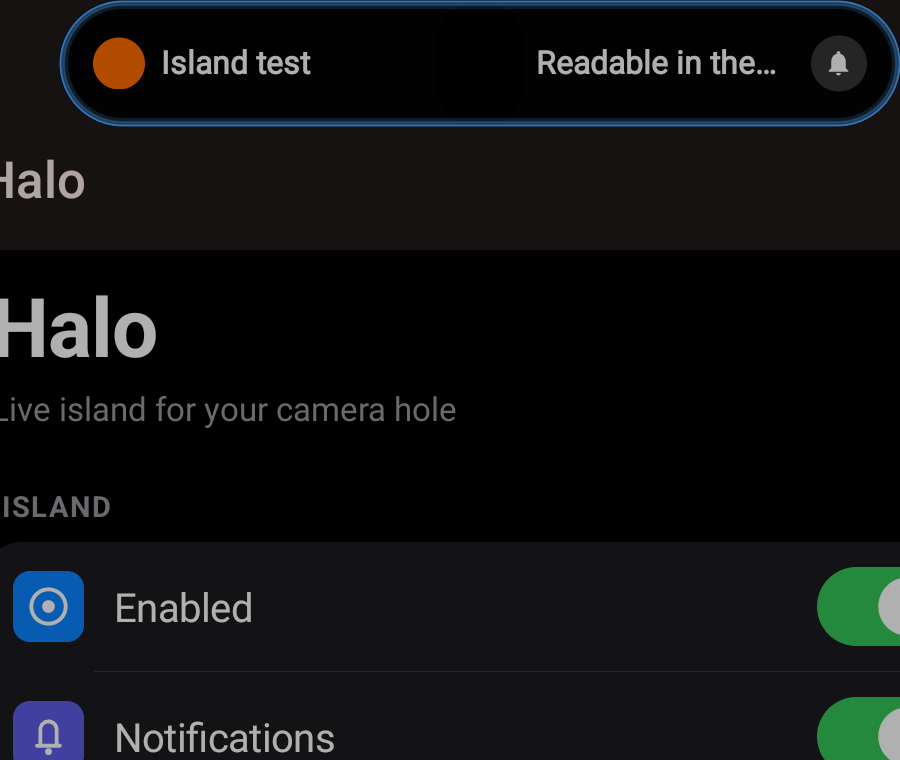 |
A message arrives. The hole widens into a capsule: app icon or sender photo, subject, and a bell when the row is silent. Swipe up on it to dismiss. |
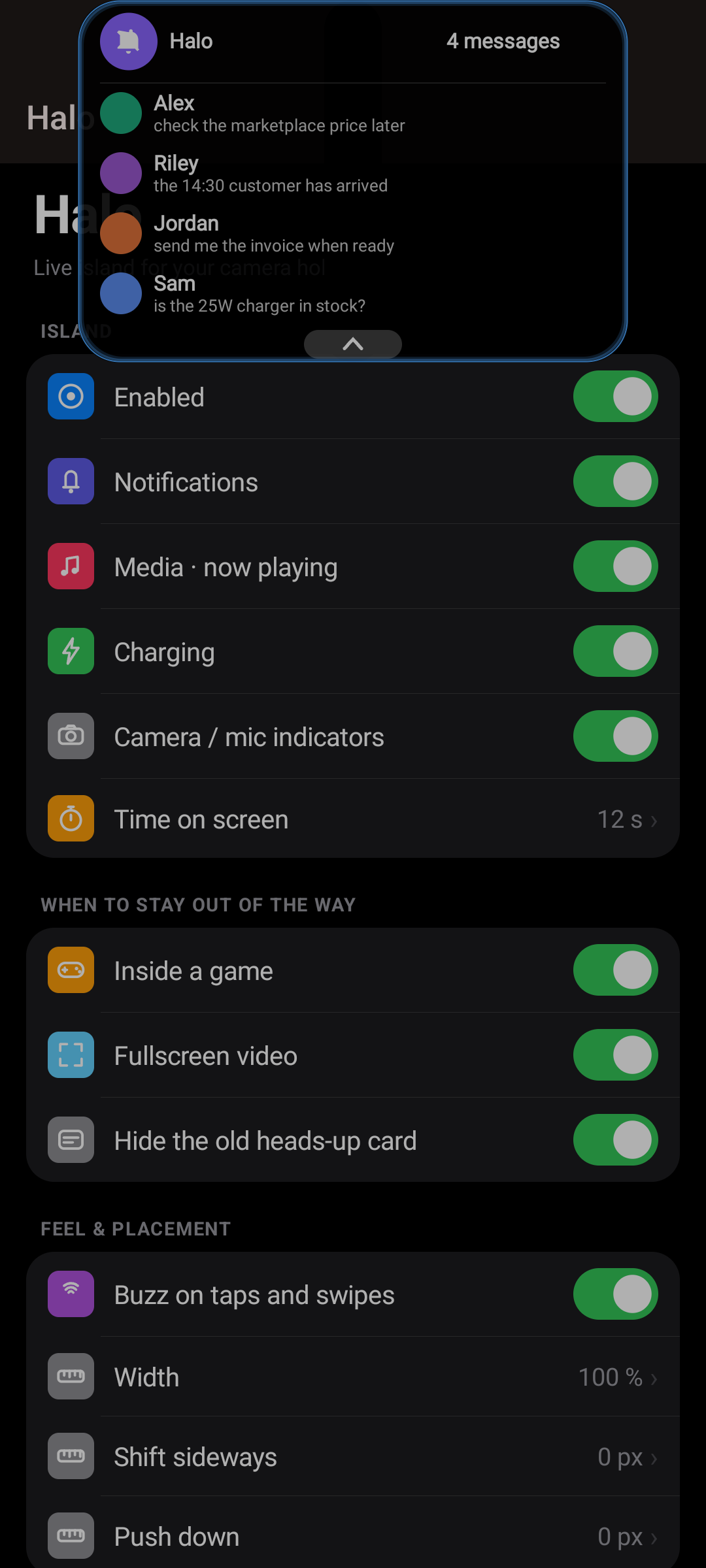 |
A burst of them. Four rows stack under a shaking bell, each one swipes away on its own; the count in the header follows. |
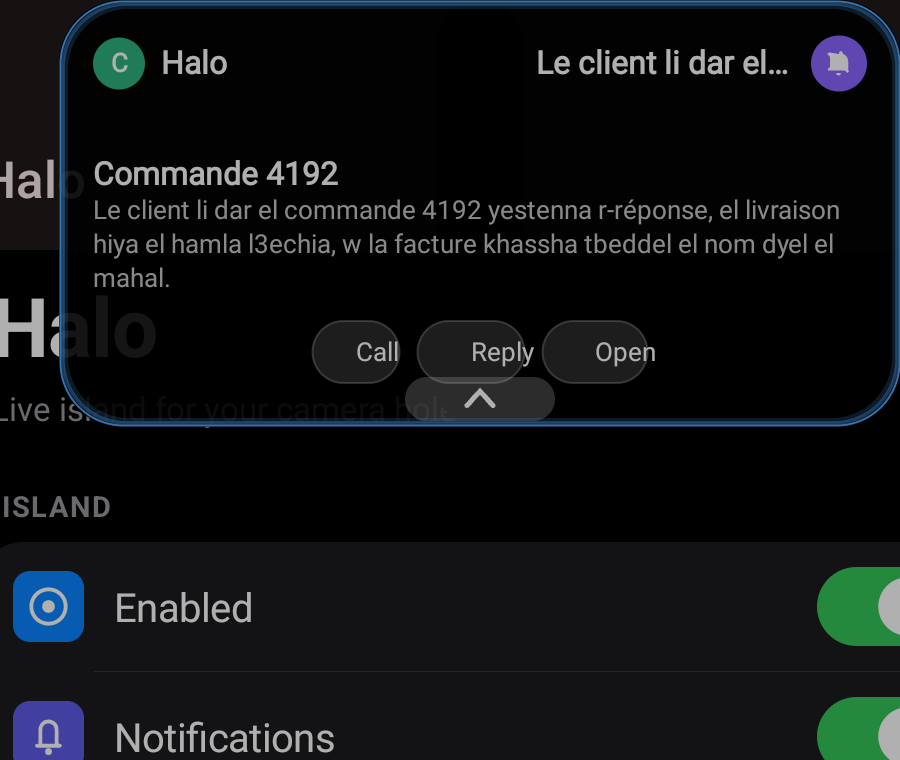 |
One tap to read. The paragraph wraps to the width of the card and the notification's own buttons become chips — Reply, Mark as read, Open all fire the real intents. |
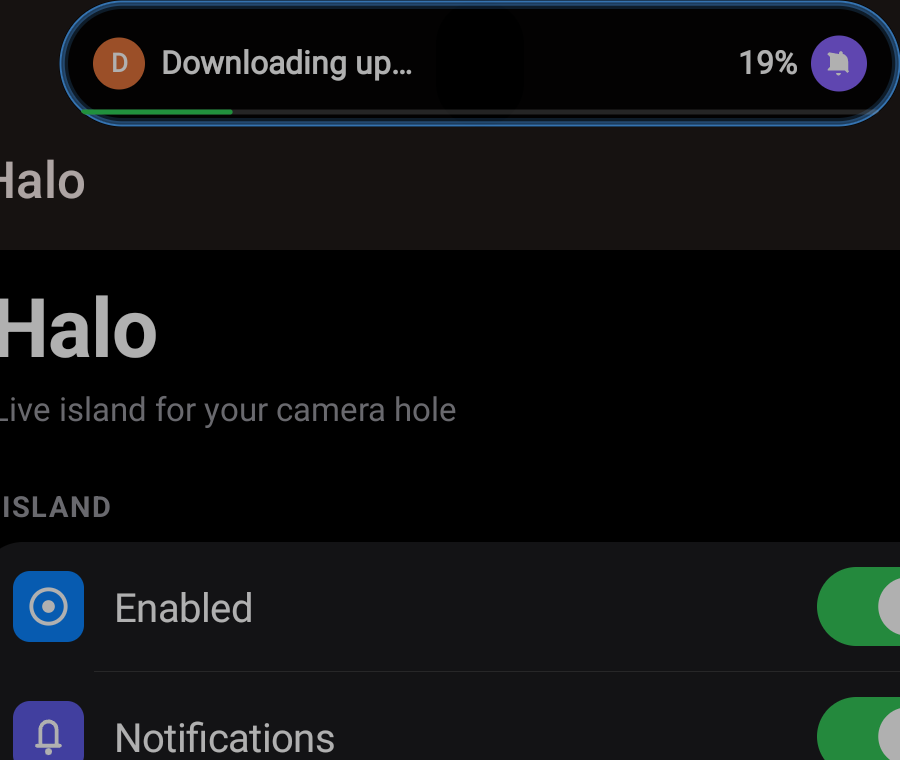 |
Something is actually transferring. A green line and a percentage, and only when the app declares a scale and the row is a running task. |
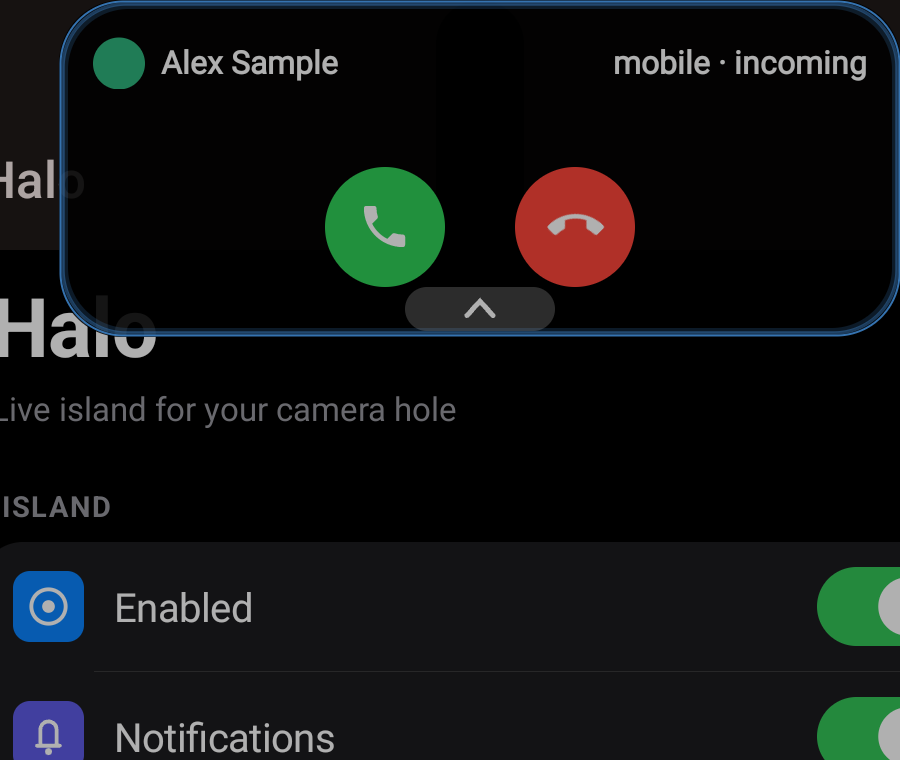 |
An incoming call. Answer and hang up as discs; once you answer, the same slot folds into a green ring. |
 |
Nothing else is happening. A light sweeps around the hole while music plays; tap it for the player. |
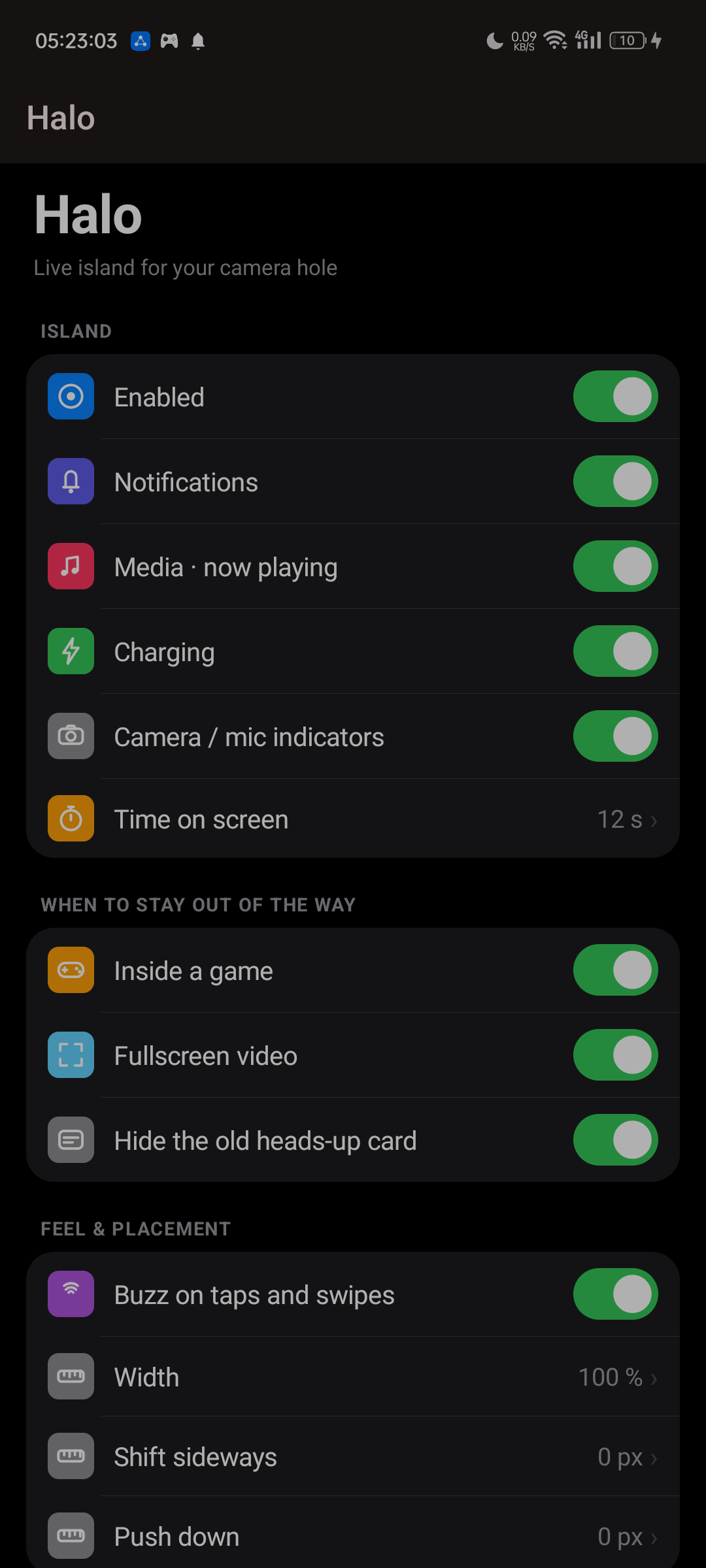 |
The settings app. Grouped cards, switches that behave like iPhone's, and a sheet for every number. |
| Notifications | The newest message expands the hole into a capsule: sender photo or initial, subject, a bell for silent rows. Swipe up to dismiss. |
| A burst of messages | Three or four rows stack into a list card with a shaking bell on the left; each row swipes away on its own. |
| One tap to open | A single message opens a detail card with the paragraph word-wrapped and the notification's own action buttons as chips (Reply / Mark as read / Open). |
| Media | Now-playing becomes a floating mini-player with artwork, transport controls and a seek line; while nothing else is up, a light keeps sweeping around the hole. |
| Downloads | A real progress bar and NN% — only when the app declares a scale and the row is an actual running task. |
| Calls | An incoming call gets a card with answer and hang-up discs; after you answer, the same slot becomes a green ring. |
| Charging | Percentage, plug/unplug, and a red ring at low battery. |
| Privacy | A coloured dot when any app touches the camera, microphone or location — read from SystemUI's own privacy list and AppOps. |
| Screen recording | A capsule while a recording is active. |
| Face unlock | One sweep of light around the hole when the device unlocks. |
| Games and fullscreen video | The island gets out of the way: Game Space's own session flag, and WindowManager's setTopAppHidesStatusBar. |
| Automation | Any app, Tasker, Termux or adb can put a capsule on screen — see the API below. |
Built and tested on exactly one phone: OPPO A79 5G, model CPH2553, ColorOS 13.1 over Android 13, rooted with Magisk, LSPosed 2.2.1, libxposed API 102. Nothing in this repository has been run anywhere else. There is no compatibility promise for any other Oppo, Realme, OnePlus or Xiaomi device, and "it's the same OEM" is not a guarantee.
What each part depends on, so you can judge your own device:
| part | depends on | elsewhere |
|---|---|---|
| Geometry of the pill | WindowInsets.getDisplayCutout() — measured, never hardcoded |
should adapt; the fractions were tuned on a 1080x2400 panel |
| Notification capture | com.android.systemui.notification.NotifCollection (AOSP-named) |
works on AOSP-derived SystemUI; some forks rename or wrap it |
| Heads-up suppression | com.oplusos.systemui.notification.helper.HeadsUpHelper and SimpleHeadsUpController |
ColorOS / Realme UI only. Elsewhere the hook simply never attaches: the island still shows, and the OEM banner shows next to it |
| Hide in games | Settings.Global/disturb_for_game_space_mode_flag |
ColorOS only. Other ROMs read 0 forever and the island stays visible in games |
| Hide in fullscreen video | CommandQueue#setTopAppHidesStatusBar |
AOSP since Android 11, the most portable of the four |
| Privacy dots | com.android.systemui.privacy.PrivacyItemController |
AOSP since Android 12, but the package layout moves between releases |
| Media, calls, charging | public framework APIs | portable |
| Sender photos | android.messages as a Bundle[], Person.getName() |
measured on this ROM; other builds may use the real MessagingStyle |
Realme UI ships the same Oplus framework as ColorOS, so a Realme phone is the most likely to
work — that is an inference from shared code, not a measurement. Android 14 and 15 are untested
and targetSdk is 33 on purpose.
If the island does not appear on your device, do this before opening an issue:
adb shell su -c 'pm grant io.github.lamin_sudo.halo android.permission.WRITE_SECURE_SETTINGS'
adb shell su -c 'settings put global a79_island_debug_log 1'
adb shell su -c 'kill $(pidof com.android.systemui)'
adb logcat -s HaloIsland | head -40
The first lines say which hooks attached and which were not found — that output is the useful part of a report.
- Rooted phone with LSPosed (tested on 2.2.1, libxposed API 102) and Riru/Zygisk provider.
- Android 13 (minSdk 33). Verified on ColorOS 13.1 / CPH2553. Other OEMs are untested: the hook targets are AOSP-named on purpose, but the geometry and the heads-up gate are ColorOS-specific.
- The module injects into
com.android.systemuionly. It never touchessystem_server.
sh gradlew :app:assembleRelease
adb install -r app/build/outputs/apk/release/app-release.apk

# give the settings app the one permission it needs to write its own config
adb shell su -c 'pm grant io.github.lamin_sudo.halo android.permission.WRITE_SECURE_SETTINGS'

# reload SystemUI so the hooks attach
adb shell su -c 'kill $(pidof com.android.systemui)'
Then open LSPosed → Modules, enable Halo, set its scope to SystemUI, and reboot once.
tools/install-release.sh does all of the above, checks the signing certificate, and prints the
LSPosed step it cannot do for you.
If the island ever misbehaves, no reinstall is needed:
adb shell su -c 'settings put global a79_island_disabled 1'   # module stands down on next boot of SystemUI
adb shell su -c 'settings put global a79_island_disabled 0' # back onadb shell am broadcast -n io.github.lamin_sudo.halo/.CustomReceiver -a io.github.lamin_sudo.halo.CUSTOM \
--es title "Order shipped" --es text "#4192 to Rafiq" \
--ei progress 60 --ei ttl 8 --es color 0xFF30D158 --es key order-4192-n (or at least -p io.github.lamin_sudo.halo) is required — an implicit broadcast to a custom action is
dropped since Android 8. In Tasker, use Send Broadcast with the package field filled in. Repeat
the same message and it shows again: the receiver bumps a sequence number, that is the event.
Stored in Settings.Global under a79_island_* because that is the one place the hooked SystemUI
process can read; changes apply live through a ContentObserver, no restart.
| key | meaning | default |
|---|---|---|
enabled |
master switch | on |
src_notification, src_media, src_charging, privacy |
per-source switches | on |
haptics |
buzz on taps and swipes | on |
games_hide |
hide while Game Space owns the screen | on |
immersive_hide |
hide while the top app hides the status bar | on |
hide_heads_up |
suppress ColorOS's own banner | off |
ttl_ms |
how long a capsule stays up | 5000 |
offset_x, offset_y, width_scale |
placement, in px and % | 0, 0, 100 |
allow_<pkg> |
per-app gate | allowed |
debug_log |
verbose logcat under tag HaloIsland |
off |
- Recorder with the microphone off is not detected. ColorOS records without a MediaProjection token, so the only signal that survives is the microphone op.
- Fullscreen detection is per-signal. Games and "the top app hides the bar" are both real WindowManager/Game Space facts. A video that keeps the status bar visible is not fullscreen as far as the system is concerned, and the island stays.
- Rows cannot be swiped away for apps that set no
deleteIntent—NotificationManageroffers no public per-key cancel on this build. - Sender photos depend on the app.
android.messagesarrives as aParcelable[]of Bundles on this ROM andPersonexposesgetName()rather thangetDisplayName(); apps that send neither fall back to the app icon. - Battery cost is not measured yet.
tools/battery-soak.shexists (two equal idle windows, module off vs the ring sweeping) but has not been run. Until it is, treat the ambient ring as unquantified — which is why the media ring only runs while something is actually playing.
- docs/HOW-IT-WORKS.md — the hook map, every measurement that shaped it, and the four routes that failed before the right signal was found.
- NOTICE — the two external sources, and the line between "measured this device" and "copied proprietary code" (there is none of the latter here).
- AGENTS.md — the rules for anyone continuing the work, including the Kotlin/interceptor trap that crashed SystemUI twice.
MIT. See NOTICE for the third-party work this was built against.